The motto is taken from Chapter 2, Verse 4 of Kena Upanishad which translates to ‘by
knowledge one attains immortality.’ Immortality here means freedom from all the bondages
of
nescience or ignorance permanently. It was founded on July 2 nd ,
1937, with this motto of imparting knowledge and empowering students through higher
education
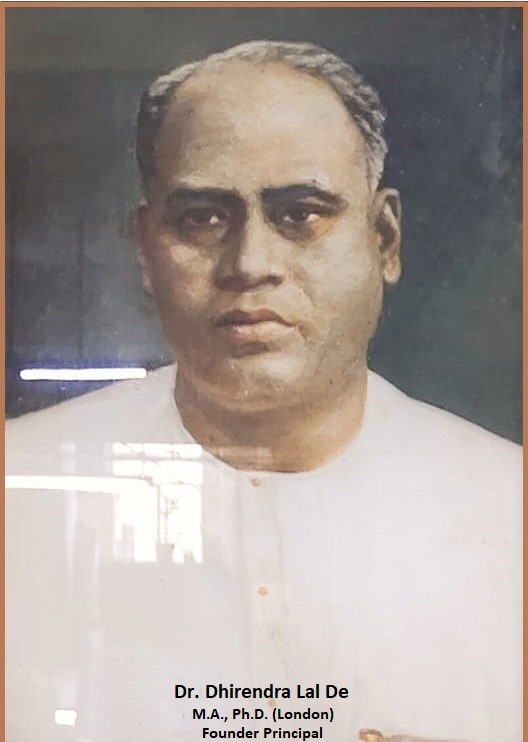
by a group of scholars under the guidance of Dr. D.L. De. A brief history of the college
shows the then avant-garde ideas which enforced innovative and progressively radical
mindsets for the upliftment of the community at large. The founder D.L. De returned to
India
after pursuing his M.A, Ph.D from London, he worked with an advisory board who wanted to
set
up a model institution for women. This advisory board consisted of eminent
personalities.
The Advisory Board with the President Sri. A. T. Ganguly submitted the application for
affiliation to the University of Calcutta. This affiliation was recommended for the
Bachelors in Arts (B.A) Programme on 27 th April, 1940 to be finally sanctioned on June,
1940. The college was established in a building in Vivekananda Road, which was then
transferred to Parshi Bagan Lane. During the Second World War, the building was taken
over by the British Government and the college shifted to 204, Cornwallis Street,
Calcutta.The Department of Bengali and the Department of English were the first two
departments to offer an Honours degree. Subsequently, other departments like Economics,
Education, Food and Nutrition, Geography, History, Hindi, Journalism and Mass
Communication, Political Science, Psychology, Sociology, were added to the college.
In this context, the college has strengthened and matured with powerful influences of
progress and educational empowerment. The NAAC Accreditation in the first cycle was B++
in 2007 and the second cycle accredited B++ in 2016.
 NSCB College